
Fragments of Forever
Fragments of Forever poem, part of the SIGNALS+ECHOES album by Vitali Liouti

The iron had been in the fire since dawn.
By the time the priest lifted it with tongs, it glowed a dull, breathing orange, and the villagers nearest the brazier turned their faces from the heat. The accused man did not turn. He looked at the iron the way you look at a sealed letter whose contents you already know.
He would carry it nine paces across the yard. Then they would bind his ruined hand in linen, seal the knot with wax, and wait three days to learn what the wound had to say.
For centuries, this was how they put their hardest questions to something higher than any human judge. They trusted the burn, the blister, the healing flesh to answer.
We kept the word: ordeal – from an old Germanic root meaning that which is dealt out. A verdict handed down from above.
The fires went out eight hundred years ago, when the Church withdrew its blessing and the iron lost its licence to speak. But the wound never spoke.
On the third day, a man bent over the linen and spoke for the wound. Sometimes mercifully. Sometimes not. The verdict was human all along. The ordeal only disguised the hands that held it.
The instinct outlived the ritual. We still show our wounds. That much is human, and good. It is the reading we keep surrendering: waiting, linen-wrapped, for someone above us to say what the wound means.
Two years ago I began writing a book. Somewhere in the middle, I understood what it had been about all along, beneath all its metal and salt: the wound will be read either way, and the reading was never meant to leave your hands.
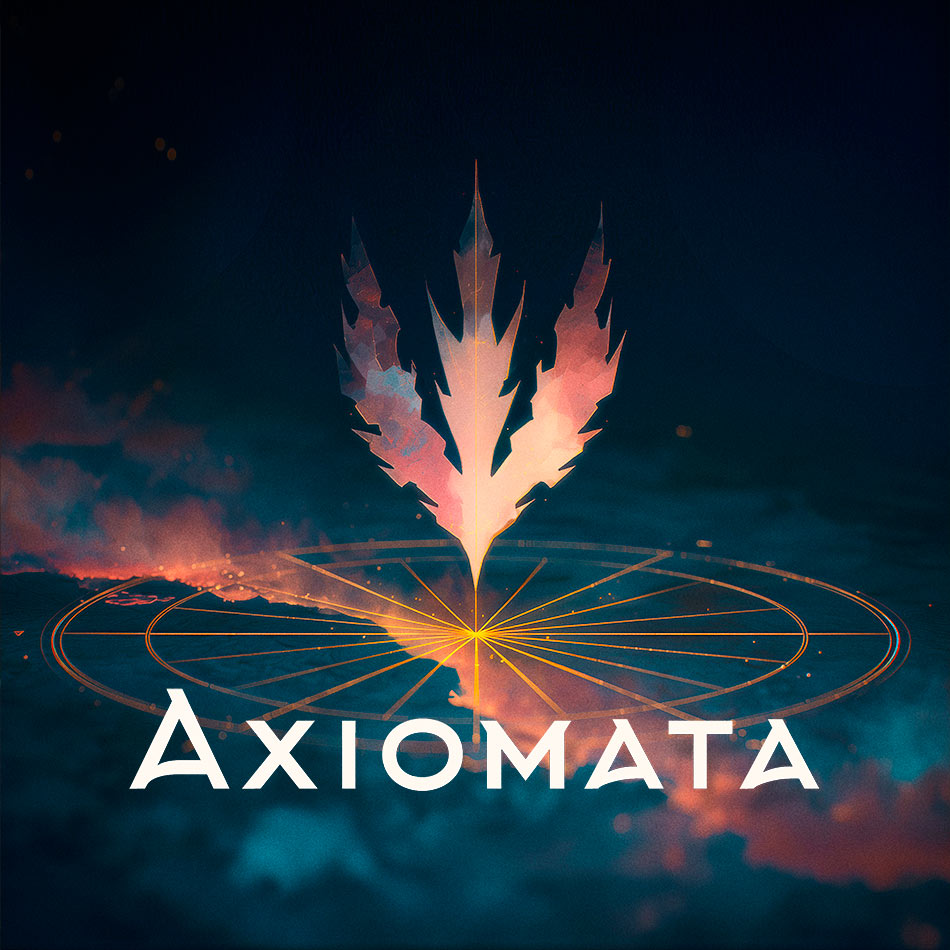
Axiomata is my attempt to hand the reading back. It is live today – free, in English and Greek.
Read Axiomata in English
Read the Greek edition
An axiom, ἀξίωμα, is that which is weighed and found worthy, from ἀξία, worth. The Greek geometers kept the word for the statements that needed no proof because they carried their own weight.
An ordeal is dealt down from above.
An axiom is weighed from within.
Axiomata is a codex of thirty-six meditations: myth, practice, and mirror. Its metaphors are for remembering yourself, standing with others, bearing power, and surrendering to what you are for.
Each begins as an image: a blade, a wound, a pearl, a drawn bow, a block of marble waiting for the hand steady enough to cut away everything it is not.
The codex does not explain these images from above. It enters them and lets them act on you.
Each image passes through three fires and a blade.
First, the metaphor: the image before it becomes an argument.
Then, the wisdom it carries: what the image knows if you stay with it.
Then, its two failures, because every virtue can die in two directions: one wound sealed before it speaks, another kept open until it forgets how to heal.
Then comes the cut: one question, aimed past the page.
Whose tremor are you still grinding out of your steel?
What shallow water did you choose to drown in?
The axiom does not answer. It leaves the reading to you.
The book has one parent, and her name is on the first page.
My mother, Eleni, is Pontic Greek. Her people had lived along the southern shore of the Black Sea for millennia, long enough for their dialect to keep old bones of the language the rest of Greek had let fall.
Then came the Pontic Greek genocide. Hundreds of thousands were killed in the early twentieth century. The survivors were driven towards homelands many had never seen, carrying a sea inside them no map could return.
The Pontic laments do not mourn the way other songs mourn. They keep the door open. Romanía was their name for the world they lost, and the most famous lament refuses to let it stay buried: even if Romanía has passed, it blooms and bears again.
My mother’s stories worked the same way. They never ended in instructions. They ended in images, and the images kept working long after she left the room – the way a splinter works, the way a pearl does.
The dedication says what two years of writing kept proving:
Dedicated to my mother, Eleni, who taught me you can hold your shape inside the fire.
The ancient Greeks gave the book its architecture. Askesis: philosophy as training, something done daily and with the hands. Sophrosyne: a string tuned to the exact tension where music lives, one breath before the snap. Telos: the end that gives a thing its form. Those words became its frame.
But she gave me the fire. The ancients only named its temperatures.
One axiom, Anamnesis, opens on a single line:
Thirst is the desert’s memory of the ocean.
On the day the codex opens, that axiom receives a second voice. Alongside the words, I have been writing music, one piece for each axiom, thirty-six in all. The first is called Nostos.
Listen to Nostos while reading Anamnesis.
Nostos is the gentlest of the old words here. It means homecoming. Its ache survives in nostalgia – nostos plus algos, the pain of the return.
But the homecoming in Anamnesis is the stranger kind my mother’s people know by heart: a return to somewhere you have never been. A thirst that remembers an ocean.
Why music? Because the codex refuses to explain, and music, mercifully, cannot footnote itself. Where an axiom asks its question, the music holds the silence after.
Nostos is the first scored reading. The others will follow, axiom by axiom.
Three things Axiomata will not do.
It will not explain.
A metaphor explained is a door painted onto a wall: accurate, and shut. Each axiom hands you the forge, the locked room, the desert, the stone, and trusts you to find where you are inside it. What the blade means in your hand is none of my business.
It will not prescribe.
This is neither a method nor a cure. The epilogue keeps only one safeguard: no one owes this book their pain. If an axiom never fits, trust the hand. Not every blade belongs to every life.
There is no final page, and no verdict waiting at the end of you. What it tempers, it tempers where no one is watching.
And it will not be paywalled.
The printed codex arrives at the end of the year, for those who want the object: stone rather than screen. But the axioms are already live, free, in English at Axiomata.org and in Greek at Axiomata.gr.
I could not write a book against borrowed light and then charge for the matches.
The yard is empty now. The fire is out. The priest is eight centuries dead.
But the old ritual did not die with him. You are still walking, nine paces at a time, linen bound tight, waiting for a voice above you to say what the burn beneath it means.
The old records confess it in spite of themselves: no one above you ever read the wound. Someone beside you did.
The codex begins where that verdict ends. It will not take the iron from you. It asks only that the first reading be yours.
When the linen comes off, whose reading are you still waiting for?
– Vitali Liouti
Axiomata
Axiomata in Greek
Nostos on Spotify
Nostos on Youtube
Fragments of Forever poem, part of the SIGNALS+ECHOES album by Vitali Liouti
A memoir where I trace my first steps with personal computers, from a 4.77MHz Schneider Euro AT in the 1980s to today's AI and VR.